
An Actual Strategy for Writing Better Headlines
10 tactics, 3 elements, 1 strategy

Hey, fellow writers. I’ve updated this post to include this link to my latest Writing Challenge:
Compose a 5-Word Headline that would sit atop a feature story about some interesting aspect of you or your life. You’ll find the challenge in the Writer’s Guide Chat Room. I look forward to reading and weighing in on each one (free mentoring!).
Now, if you need some headline-writing help…
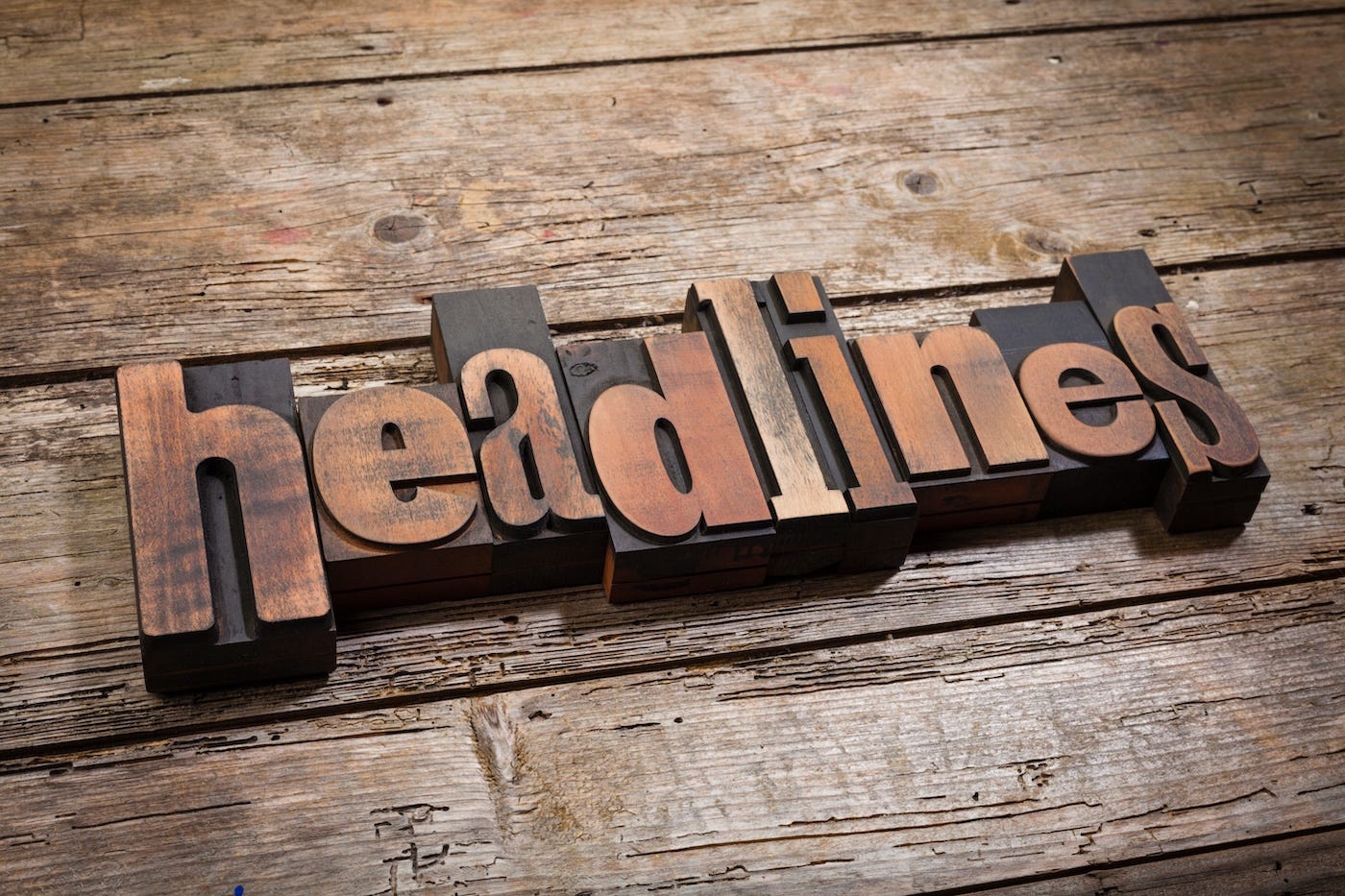
Headlines have one purpose: Get people to read your story. Yes, they have to be honest, never a trick, but otherwise the headline’s only job is to lure readers in. One can argue the headline is the most important element of a story. Sure, a great story might overcome a mediocre headline, but why risk it?
However…
While some people are naturals at headline writing, for many writers who have to write their own, headlines are a bugger.
If you’re not a headline maven, take heart. You’re the norm, not the exception. Nobody taught this in school. But we’re going to work on your skills.
What, I have to write the hed?!
When I worked in newspapers back during the Paleozoic, we had specialists who wrote headlines (heds, in editor-speak). They were seasoned pros who had the knack.
Ideas would sometimes fly around the newsroom, brainstorms that welcomed half-baked suggestions and the inevitable duds. Hours might be spent on an important headline, only to have it changed at the last second before going to press after finally, finally, somebody shouted out a winner.
Nowadays, many writers are expected to be proficient in a craft that was once handled mostly by specialists.
If headlines are not your specialty, what you need are some proven tactics to help you improve.
3 elements of great headlines
I’ve written thousands and thousands of headlines over the years, for print and online, across topics including science, health, biz, tech, sports and general news. I’ve learned tactics from some of the best, and I’ve developed three foundational elements of great headlines, whose sole purpose is to get people to read the story:
The best headlines are:
Clear: Don’t be vague. Readers should “get it.”
Concrete: Use specifics, not generalizations.
Compelling: Don’t be boring!
Sometimes a hed writes itself , but more often we have to work at it. So here’s an important rule of headline writing:
Never assume the first one you dream up is the best one. It usually is not. Especially if you came up with it before you wrote the story.
Stories often drift. The premise may remain, but the details evolve during the writing, tone might change, predominant elements shift. Some of those new and evolving details may be excellent headline material. A key fact. A crucial stat. A telling quote.
Headlines get stuck in our heads, however. Once you write one, it’s hard to imagine another.
The strategy
Imagining other headlines, then, requires a strategy. Here is the foundation of my strategy:
Write at least three headlines for every story.
Sometimes I’ll write five or 10. Never fewer than three, even if I think the first one is perfect. And I force myself to make each one significantly different, which often leads to well more than three.
Here are 10 of the tactics I use often:
Revisit the premise. What is the story’s main point?
Work with the most important noun and verb in the story.
Try different conceptual angles—totally different flavors.
Play with (and without) different verbs, with or without adjectives.
Try long, try short (KISS is often best).
Be straightforward, then offbeat.
Flip the order of the words (put the subject after the object, for example)
Put the most important word in the very front.
Turn the hed into a question.
Ask a friend!
(If a friend comes up with something totally surprising, it might even lead you to wonder if the story is doing what you intended.)
If you find a favorite, or one that feels close, create three more in the same vein, using the same key elements, while once again employing the tactics above. Sometimes riffing on one idea will render it stale (the way repeating a word over and over can make it sound strange) and you’ll have to go back to square one.
Did I say headline writing was challenging?
Would you click?
Finally, ask yourself: Would I click on that? If the answer isn’t an emphatic “Yes!” keep brainstorming. (You can show the hed to a friend, too, and ask the same question.)
People will argue about how long headlines should be. I wrote an entire post about that. Here’s the gist:
Every story is different, every platform/publication is different. Every audience is different. A headline should be as long (or short) as necessary to be effective given those variables. Long headlines can work, but they’re harder to pull off successfully, especially in some online formats where they get chopped off in displays.
Often, the best headlines are short—five words or less, maybe seven tops. That’s a helpful hint, not a guideline. But do yourself a favor and force some short ones into your brainstorm—I always challenge myself to come up with at least one five-worder. Here’s a model for the simplest and often most effective headlines:
Subject > verb > object + maybe an adjective.
The tactic works wonders, and it reminds us to avoid extraneous words like “a” and “the” and “an” as much as possible, whenever readers’ brains will fill those words in. To be clear, you’ll rarely hit upon a perfect three-word headline, but it doesn’t hurt to try. Example:
A Man Bites a Dog (too many words!)
Man Bites Dog (way better)
Things to not do:
Don’t get overly clever at the expense of clarity.
Avoid mere labels. If you don’t have a verb, you likely have a mere label atop your story, not a headline.
Don’t rush. I like to sit on my hed for 24 hours. A better one often emerges the next day.
A headline has one job: Get people to click. Of course, there are no rules, only guidelines. But your heds should almost always be concrete, rarely anything but clear, and always, always compelling.
Cheers,
Rob
Do you enjoy writing headlines or agonize over them? Any helpful tricks?
TIDBITS OF WRITING WISDOM
Stuff that pops into my head as I write and edit…
Write tight: Pithy is an underused word and a great writing goal.
Which way? If you have a story idea that could go in three directions, write them.
Story recipe: Unfinished article drafts are often like salad that needs dressing, or dressing that wants a salad. Figure out which, and then you’ll know what ingredients to add.
Stay sharp: Journalist Bryan Schwartzman made a nifty comparison between using AI to assist writing and using a maps app when you’re driving: “Using a GPS destroyed my mental map and navigation skills,” he wrote on Linkedin. Yep, me too. I’ve been to nearby businesses several times and still can’t find them without Google Maps. Were that sort of diminishment to happen to my writing skills, I would cry.
Just do it: Hitting the “publish” or “send” button is an act of bravery. Be brave.
A LITTLE INSPIRATION
Nobody cares that writing is hard for you.
Nobody cares that writing doesn’t pay your bills.
Nobody cares that nobody reads your stories.
But I do.
Until next week, write on!
—Rob
End of Story
Your story is too long. Doesn’t matter which one you’re thinking of. It’s too long.
###
Headline: Reader Appreciates Story!
DOGE'd Fed Pivots to Sci-Fi